黃仁勳開通社交賬號,首條推文發了啥?
一夜漲粉70萬!黃仁勳首條推文引爆全網,網友:這是要當網紅了?
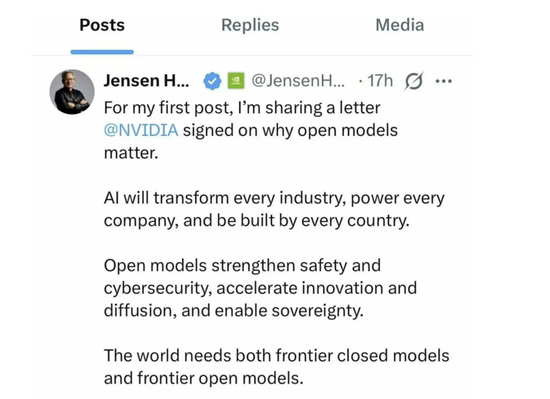
7月24日晚間,英偉達首席執行官黃仁勳在社交平台 X 發布個人入駐後的第一條推文,並未推介公司芯片與產品,而是直接附上題為《開放權重與美國在AI領域的領導地位》的聯合公開信,為開放權重AI模型背書。
瞬間引爆全球科技圈與資本市場。
本次共有英偉達、微軟、Meta、IBM 等25 家美國頂級科技企業、投資機構與開源基金會聯合署名,成為今年立場最鮮明、影響最深遠的 AI 行業宣言。
這封公開信直面當下美國 AI 監管爭議,核心推翻了市場固有認知:
一國 AI 競爭力,不在於能否壟斷最強閉源大模型,而在於能否搭建開放、可擴散、可自主掌控的全民 AI 生態。
文章以 80 年代開源軟件革命為歷史參照,論證開放權重模型是技術普及、產業競爭、網絡安全與數字主權的核心基石。
公開信明確表態:
盲目封禁開放權重 AI,只會扼殺創新、轉移產業優勢、製造技術壟斷風險。相比於封閉模型的單點隱患,開源體系能夠依靠全球開發者共同審查、迭代修復漏洞,反而具備更強安全韌性。
同時,開放模型大幅降低 AI 創業與產業落地門檻,讓初創企業、高校與傳統行業無需從零訓練模型,真正實現技術普惠。
信中最終給出時代定論:
AI 未來必須雙軌並行,頂尖閉源模型保障極致性能,頂尖開放模型保障生態活力。
附上公開信完整英文原文 + 權威中文精譯,全文無刪減、無篡改
黃仁勳 X(原 Twitter)
英文原文
For my first post, I‘m sharing a letter @NVIDIAsigned on why open models matter.AI will transform every industry, power every company, and be built by every country. Open models strengthen safety and cybersecurity, accelerate innovation and diffusion, and enable sovereignty. The world needs both frontier closed models and frontier open models.
中文譯文
這是我的第一條帖子,我分享一封英偉達參與聯署的公開信,闡釋開放模型為何至關重要。人工智能將重塑各行各業,賦能每家企業,並由世界各國共同建設。開放模型能夠強化安全與網絡防禦,加速創新與技術普及,實現技術主權。世界既需要頂尖閉源模型,也需要頂尖開放模型。
中文完整譯文(嚴謹直譯)
開放權重模型,即任何人都可下載、審查、修改並在自有基礎設施上運行權重的人工智能模型,對維持美國在人工智能領域的領導地位至關重要。
當前華盛頓正在展開一場辯論:
是否應當限制開放權重模型。許多人擔憂開放權重可能遭到濫用,這類顧慮值得嚴肅對待。但限制開放權重將會損害美國的創新能力、市場競爭、網絡安全與數字主權,反而讓海外競爭對手獲得優勢。
歷史提供清晰參照:上世紀 80 年代開源軟件的興起。早期開源先驅打破了一種觀念 —— 軟件進步只能依靠嚴格管控的專有代碼。他們搭建起透明生態,全球開發者能夠學習、修改、改進共享技術。如今,開源軟件支撐互聯網絕大部分基礎設施,成為各大科技巨頭的底層底座,在美國創造數百萬就業崗位。
開放權重模型將同樣的發展邏輯帶到人工智能領域。
初創企業、高校、公共機構與工業主體,無需從零訓練前沿大模型,就能夠基於頂尖 AI 開展研發。這擴大經濟參與機會、降低行業准入門檻、充分激發競爭,創新不再侷限於少數資金雄厚的實驗室。
評判美國的 AI 領導力,不應以能否掌控單一前沿模型作為標尺,而要看美國能否搭建一套滲透各行各業、穩健開放的人工智能生態。開放權重模型正是這套生態的基石。
批評者提出的風險客觀存在:
模型對外發布後,開放權重可以被第三方修改,脫離原始開發者管控。但全面禁止並非正確解決方案。限制措施無法消除風險,只會促使風險向不透明的閉源體系轉移,同時倒逼相關產業流向海外。僅僅依靠閉源模型,並不能天然保障安全。閉源系統同樣面臨黑客入侵、濫用、運行故障等問題;將先進 AI 能力集中在少數封閉體系中,反而製造單點重大風險。
開放體系能夠強化安全水平。當成千上萬研究者可以審查模型權重,漏洞能夠更快被發現與修復。開放權重同時推動數字主權建設:各國與企業能夠依託自有硬件運行 AI,不必受制於境外服務商。
政策制定者應當制定針對性防範濫用的保障機制,而非大範圍封禁開放權重。監管規則需要區分合法對模型進行適配改造與非法竊取知識產權兩類行為。監管機構應當鼓勵分層安全機制、信息透明原則與自願安全標準落地。
想要充分釋放人工智能價值,世界既需要頂尖閉源模型,也需要頂尖開放權重模型。限制開放權重,會削弱美國競爭優勢;擁抱開放權重,才能持續維繫美國創新活力、強化網絡安全,守住全球人工智能競賽中的領先地位。
Open Weights and American AI Leadership《開放權重與美國人工智能領導力》
Open weights models — AI models whose weights anyone can download, inspect, modify, and run on their own infrastructure — are essential to sustaining American leadership in artificial intelligence.
Today, a debate is underway in Washington about whether to restrict open weights models. Many fear open weights could enable misuse. These concerns deserve serious consideration. But restricting open weights would undermine U.S. innovation, competition, cybersecurity, and national sovereignty. It would hand an advantage to competitors overseas.
History offers a clear parallel: the rise of open-source software in the 1980s. Early open-source pioneers challenged the idea that software progress depended solely on tightly controlled proprietary code. They built transparent ecosystems where developers worldwide could learn, modify, and improve shared technology. Today, open-source software powers most of the internet, underpins every major tech company, and created millions of jobs across the United States.
Open weights models bring the same dynamic to artificial intelligence. They let startups, universities, public agencies, and industrial operators build on state-of-the-art AI without training frontier models from scratch. This expands economic participation, lowers barriers to entry, and fuels competition. Innovation is no longer confined to a small set of well-resourced labs.
American AI leadership should not be measured by control over a single frontier model. It should be measured by our ability to build a robust, open AI ecosystem deployed across every industry. Open weights models are the foundation of that ecosystem.
Critics rightly note risks: once released, open weights can be modified and used outside the original developer’s control. But prohibition is the wrong remedy. Restrictions will not eliminate risk; they will shift risk toward opaque, closed systems and push development offshore. Reliance only on closed models does not guarantee safety. Closed models can be hacked, misused, or fail. Concentrating advanced AI capability in a small number of closed systems creates single points of failure.
Open systems strengthen security. When thousands of researchers can inspect model weights, vulnerabilities are found and fixed faster. Open weights also advance digital sovereignty: nations and companies can run AI on their own hardware, independent of foreign providers.
Policymakers should pursue targeted safeguards against misuse rather than broad bans on open weights. Rules should distinguish between legitimate adaptation of models and unlawful theft of intellectual property. Regulators should encourage layered security practices, transparency, and voluntary safety standards.
The world will need both frontier closed models and frontier open models to maximize AI benefits. Restricting open weights weakens America’s competitive edge. Embracing open weights will sustain U.S. innovation, strengthen cybersecurity, and preserve American leadership in the global AI race.